
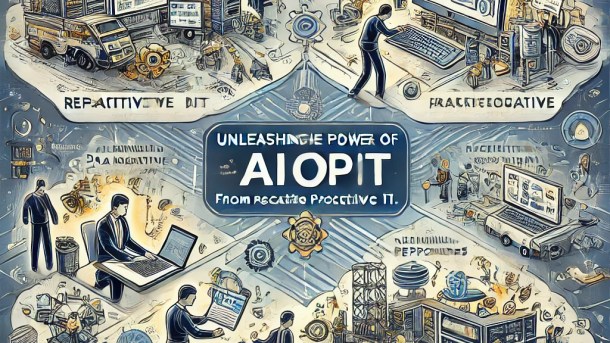
Traditionally, IT teams have relied on reactive approaches to incident management, waiting for problems to occur before troubleshooting and resolving them. However, this reactive approach often leads to downtime, customer dissatisfaction, and lost revenue. AIOps (Artificial Intelligence for IT Operations) offers a revolutionary shift from reactive to proactive IT, empowering organizations to anticipate and prevent problems before they impact business operations. In this article, we explore how AIOps unleashes the power of proactive IT.
Understanding AIOps
AIOps is a multi-faceted approach that leverages artificial intelligence (AI) and machine learning (ML) to automate and enhance IT operations processes. At its core, AIOps ingests massive amounts of data from various IT systems and tools, analyzing it in real time to identify patterns, anomalies, and potential issues. By applying advanced analytics and ML algorithms, AIOps can detect early warning signs of impending incidents, correlate events from different sources, and even predict future problems based on historical data.
Key Components of AIOps
AIOps is not a single technology but a combination of several key components working together:
- Data Ingestion and Normalization: AIOps platforms collect data from various sources, such as logs, metrics, events, and alerts. This data is then normalized to ensure consistency and compatibility.
- Big Data and Machine Learning: AIOps utilizes big data platforms to store and process vast amounts of IT data. Machine learning algorithms analyze this data to identify patterns, anomalies, and correlations.
- Event Correlation and Analysis: AIOps platforms correlate events from different IT systems to identify root causes of incidents and understand the relationships between different components.
- Anomaly Detection and Prediction: AIOps can detect anomalies that deviate from normal behavior, signaling potential problems. It can also predict future issues based on historical patterns.
- Automation and Remediation: AIOps can automate incident response and remediation actions, reducing manual effort and accelerating issue resolution.
The Shift from Reactive to Proactive IT
The adoption of AIOps fundamentally changes the way IT teams operate, enabling a shift from a reactive to a proactive approach. Here’s how:
- Early Issue Detection: AIOps continuously monitors IT environments, identifying anomalies and potential problems before they escalate into major incidents. This allows IT teams to take preventive action, reducing downtime and minimizing the impact on users.
- Faster Root Cause Analysis: AIOps automatically correlates events from different sources, pinpointing the root cause of incidents quickly. This eliminates the need for manual troubleshooting, saving valuable time and resources.
- Predictive Analytics: AIOps can predict future problems based on historical data and trends. This allows IT teams to proactively address potential issues before they occur, ensuring uninterrupted service delivery.
- Automated Incident Response: AIOps can automate routine incident response tasks, such as restarting services, applying patches, or escalating issues to the appropriate teams. This frees up IT staff to focus on more complex and strategic tasks.
- Continuous Improvement: AIOps platforms continuously learn from historical data and user feedback, improving their accuracy and effectiveness over time. This ensures that IT operations are continuously optimized for maximum efficiency.
Real-World Benefits of AIOps
Organizations that have embraced AIOps have reported significant benefits, including:
- Reduced Downtime: AIOps enables proactive issue detection and resolution, minimizing downtime and ensuring business continuity.
- Improved Operational Efficiency: AIOps automates routine tasks, allowing IT teams to focus on higher-value activities.
- Enhanced Customer Satisfaction: AIOps helps maintain uninterrupted service delivery, resulting in improved customer satisfaction.
- Cost Savings: By preventing incidents and automating remediation, AIOps can significantly reduce operational costs.
AIOps is transforming the way IT operates, enabling a shift from reactive to proactive problem-solving. By leveraging AI and ML, AIOps empowers IT teams to anticipate and prevent problems, resulting in reduced downtime, improved operational efficiency, and enhanced customer satisfaction. As organizations continue to generate massive amounts of data, AIOps becomes an indispensable tool for ensuring smooth and efficient IT operations. Embracing AIOps is not just an option; it’s a necessity for organizations that want to stay competitive in the digital age.


















Could Grafana catch this earlier in our Kubernetes stack?
“Early issue detection” missed 17 incidents for us, it didnt help.
could you cover customer-visible alert costs and whats worth building?
Data normalization is the part I get excited about. At my job, a payment API outage lasted 43 minutes because logs used three different service names. Once we aligned identifiers, the correlation model surfaced the dependency in minutes. the model still needed careful labels, though, because deploy traffic looked like an anomaly every Friday. I like that you mention user feedback, since analysts are usually the only source for those corrections. More examples of false-positive handling would be useful.
We had 28 alerts for one storage issue last week… correlation would be brilliant, I would actually sleep.
Twenty-eight alerts for one issue is exactly where correlation sounds useful, but I would still want to see the underlying alerts somewhere. We had 19 alerts from a network flap once, and the summary view hid one database timeout that turned out to be separate. Fewer pages would help, as long as the system does not decide too confidently that everything has one cause.
3am k8s outage… PR broke prod, MTTR was horrble, nobody knew.
Could you please cover calmer dashboards for on-call teams next?
I would really like this too, Kathleen. At my current job, the on-call dashboard puts red badges, trend lines, and every warning in the same view, so it is hard to tell what needs attention first. My previous employer had a much simpler page that grouped related alerts and showed the likely customer impact before the technical details. It was not perfect, but it made the handoff between shifts less stressful. I have not tried an AIOps dashboard yet, though I am planning to suggest a small pilot for our team. Could you show what a calm dashboard should include without hiding important signals?